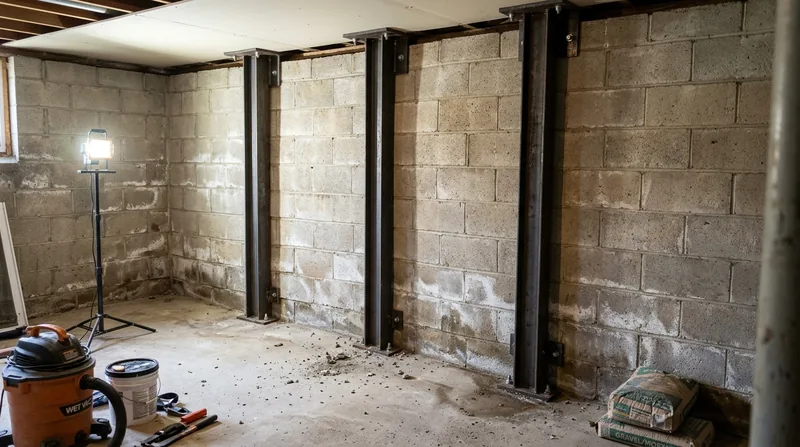




Bowing Wall Repair in Germantown: Stop the Pressure Before the Wall Moves Further
If you have noticed a foundation wall leaning inward, a horizontal crack running the length of the block course, or a basement wall that is visibly out of plumb, you are looking at Bowing Wall Repair in Germantown territory, and the cause is almost always hydrostatic pressure from wet clay pushing against a wall that was never built to resist it. Germantown sits on clay-loam and silty soil over Piedmont schist and gneiss that weathers into heavy clay, so water leaves the lot slowly and loads the foundation wall season after season.
The 1980s to 2000s subdivisions in Kingsview, Neelsville, and the town core have poured full basements that usually hold up well, but the older block walls in Montgomery Village and the stone or early block cellars on farm properties toward Clarksburg, Damascus, and Poolesville are where we see the movement. A hard freeze followed by a wet spring is the classic trigger. If you want the full picture of how water reaches the wall, start with our basement waterproofing overview, then bring us in to assess the wall itself.
Why Bowing Walls Are a Germantown Problem, Not a Cosmetic One
A bowing wall is a structural signal, not a finish issue. The soil here holds water for days after a summer storm, and the ridges above Seneca Creek branch send runoff down into the low ground fast. That wet clay exerts lateral hydrostatic pressure against the wall, and a block wall with a horizontal crack at mid-height is already telling you it is carrying more load than it can take.
- Horizontal cracks in the block courses point to soil pressure, while vertical cracks usually point to settlement or shrinkage.
- Efflorescence on the wall face means water is moving through the masonry and leaving mineral salts behind.
- A wall that is out of plumb by more than an inch over eight feet needs to be measured, not ignored.
- Doors and windows that stick on the upper floors can indicate the wall is rotating inward at the top.
We measure the movement, check the wall for prior patching, and tell you plainly whether the wall needs stabilization or whether the water load behind it is the real problem to solve first.
Key info: In Montgomery Village split-levels from the 1960s and 1970s, we often find block walls with a horizontal crack and a partly finished basement. The wall has been bowing slowly for years, and the homeowner only notices after a wet spring pushes water through the crack. That is the point to call (240) 261-0659, before the movement accelerates.
For the code side, structural foundation repair permits are commonly required, and the rules vary by jurisdiction, so confirm the requirement with the Montgomery County Department of Permitting Services before work begins. We can point you to the right office, but the permit is the homeowner's to verify.
How We Stabilize a Bowing Wall in Germantown
The repair method follows the severity of the movement and the pressure of the wet clay behind it. We start with a free basement inspection that includes measuring the wall's plumb and mapping the crack pattern, then we match the method to what the wall is actually doing. Carbon fiber straps are the right call for moderate bowing on a block wall, while steel I-beams or wall anchors handle heavier movement and deeper soil pressure.
- We measure the wall's out-of-plumb and document every crack, so the repair is based on numbers, not guesswork.
- We check the drainage on the lot, including grading and downspout extensions, because wet clay behind the wall is the load we are fighting.
- We install carbon fiber straps or steel I-beams on the interior face, anchored into the floor and the floor joists above.
- We epoxy-inject or polyurethane-inject active cracks so water stops moving through the wall while the straps take the load.
- We correct the water source with an interior perimeter drain and sump basin where hydrostatic pressure is the driver, so the wall is not re-loaded after the repair.
If the wall is bowing because water is stacking up behind it, stabilizing the wall without fixing the drainage just buys time. That is why we look at the whole system, and why our interior drain tile system work is often part of the same job.
Key info: A homeowner in Damascus with an early block cellar wall had a horizontal crack and a wall leaning about two inches over eight feet. The clay behind it stayed saturated through the spring. We installed steel I-beams on the interior, injected the crack, and added an interior perimeter drain with a sump basin. The wall is now stable and the basement stays dry through the summer storms.
Matching the Repair to the Wall: Methods We Use
There is no single fix for every bowing wall. The table below shows how we match the method to the severity of the movement and the soil pressure behind the wall, based on what we find during the inspection.
| Approach | Description | Best for |
|---|---|---|
| Carbon fiber straps | Straps bonded to the interior wall face and anchored into the floor and joists | Moderate bowing on block walls with limited movement |
| Steel I-beams | Vertical steel beams set against the wall and tied into the floor structure | Heavier movement and deeper soil pressure |
| Wall anchors | Exterior anchor plates tied through the wall to interior plates | Walls that need to be pulled back toward plumb |
| Epoxy or polyurethane injection | Injection ports set into cracks and filled to seal the wall | Active cracks that are letting water through |
We often combine methods on the same wall, and we tell you which combination fits your wall and your budget.
Bowing Wall Repair Cost in Germantown: What to Expect
Bowing wall repair pricing starts at $600 for a targeted crack injection or a small stabilization scope, and climbs from there based on how far the wall has moved and how much soil pressure it is carrying. A carbon fiber strap system on a moderate bow costs more than a single injection, and steel I-beams or wall anchors on a heavily loaded wall cost more again. The number is driven by the wall, not by a menu.
Factors that move the price include the length of the wall, the number of straps or beams required, whether the crack is active, whether drainage work is needed to relieve the pressure, and access to the basement. A finished basement with drywall in the way adds labor. Getting two or three estimates is smart, because a bowing wall is a structural call and you want to compare the diagnosis, not just the number. Our full pricing overview lays out the ranges, and the free inspection gives you a firm number for your wall.
Bowing Wall Repair Near Me: What to Check Before You Hire in Germantown
When you search for bowing wall repair near me, the first thing to confirm is that the contractor is licensed and insured for structural foundation work in Maryland, and that they will show you the certificate. Ask for references from jobs in Germantown or the surrounding upcounty, and ask what method they used and why. A contractor who cannot explain the difference between a strap and a beam, or who wants to inject a crack without addressing the pressure behind it, is not the right call.
Confirm who pulls the permit, since structural foundation repair commonly requires one and the rules vary by jurisdiction. If you are in a subdivision with an HOA, check the architectural rules before exterior work. We are happy to walk you through the process, and you can reach us through our contact page to schedule the free inspection.
Bowing walls do not fix themselves, and the wet clay in Germantown will keep loading the wall every spring. Call (240) 261-0659 and we will measure the movement, explain the options, and give you a straight answer on what your wall needs.
Bowing Wall Repair in Germantown: Pricing Guide
| Service | Price | Details |
|---|---|---|
| Crack injection (epoxy or polyurethane) | Starting at $600 | Includes injection ports and sealing of one active crack, priced by crack length and wall access |
| Carbon fiber strap system | Starting at $1,800 | Includes straps anchored into floor and joists, priced by wall length and number of straps |
| Steel I-beam stabilization | Starting at $3,500 | Includes beams tied into the floor structure, priced by wall height and severity of movement |
| Wall anchor system | On estimate | Requires an on-site look at exterior access and soil pressure before a number is given |
| Travel | Included | In Germantown and surrounding areas, no separate call-out or mileage fee |
| Estimate | Free | Response within 24h at (240) 261-0659, no obligation to book |
Indicative pricing, the exact cost depends on square footage, finish, and site access. Free personalized estimate within 24h at (240) 261-0659.


