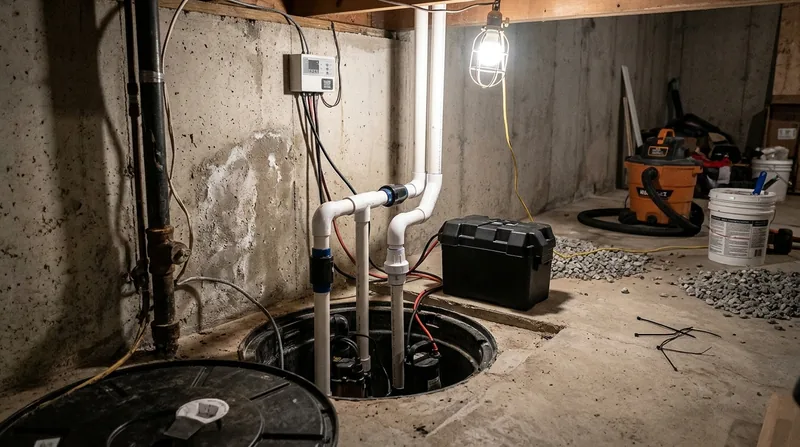




Battery Backup Sump Pumps in Germantown: Keep Your Basement Dry When the Power Fails
Germantown sits on clay-loam and silty soil over Piedmont schist and gneiss, and that ground holds water instead of shedding it. Summer storms run off the ridges and flash flood the low ground around Seneca Creek, spring rains push the water table up, and every one of those events sends water to the footing drain and into the sump basin. When the grid drops during the same storm, a single pump with no backup stops dead. Battery Backup Sump Pumps in Germantown keep the basin emptying through an outage, and we size the battery, charger, and alarm to your pit instead of selling a box off a shelf. If you have heard the pump cycle hard after a July downpour, this is the page to read before the next one. Start with a free basement inspection and we will tell you what your pit actually needs.
Why a Backup Pump Matters in Germantown's Clay and Storm Cycles
Most Germantown basements were poured between the 1980s and 2000s in Kingsview, Neelsville, and the town core, and the typical full poured basement here leans on one primary pump. The clay-loam soil drains slowly, so a storm that drops two inches in an hour keeps feeding the drain tile for hours afterward. That is exactly when outages hit, and a dead pump means water climbs the basin and reaches the floor joint.
- Summer thunderstorms knock out power at the same moment inflow peaks, so the backup runs when the primary cannot.
- Spring rains raise the water table for weeks, and the pump cycles around the clock with no rest.
- Freeze-thaw cycles crack older walls in Montgomery Village and Clarksburg, adding seepage the pump must handle.
- Older farmhouses in Damascus and Poolesville have stone or early block cellars where a failed pump floods fast.
A backup pump does not replace the primary. It buys you the hours or days until power returns, and that is the whole point.
Key info: A homeowner in Kingsview lost power for 14 hours during a July storm. The primary pump stopped, water rose six inches in the basin, and the finished half of the basement took on water at the floor joint. A properly sized backup with a float alarm would have run the whole outage.
For the official word on storm preparedness and power outages in the county, see Montgomery County Government.
How We Size and Install a Backup System in Germantown
We do not guess at battery capacity. We measure the pit, check the primary pump's discharge rate, and calculate how much inflow your drain tile delivers during a storm. Then we match a backup pump and battery that can carry that load, and we test the whole setup under a simulated outage before we leave.
- We inspect the sump basin, check valve, and discharge line, and confirm the primary pump is working before adding a backup.
- We measure pit depth and diameter and calculate inflow from your drain tile and footing drain during wet weather.
- We select a backup pump with the right head pressure and a battery sized to run it for the outage length you want.
- We install a separate discharge line and check valve so the backup does not fight the primary.
- We wire the charger, mount the float switch, and set a high-water alarm you can hear upstairs.
- We run a live test by cutting power to the primary and watching the backup carry the basin.
Every install ends with that test, and we walk you through the alarm and the maintenance schedule before we pack up.
Key info: In a 1960s split-level in Montgomery Village, the pit was only 18 inches deep and the original pump sat on a brick. We set a proper basin, added a backup with a 12-hour battery, and ran the discharge to a freeze-protected line. The homeowner tested it during the next nor'easter and the backup ran clean.
If your pit or drain tile needs work first, we handle that through sump pump installation and replacement before the backup goes in.
Backup Pump Options We Install in Germantown
There is no single right backup for every basement. The choice comes down to how long you want to run without power, how much inflow your drain tile delivers, and whether you want a maintenance contract that tests the battery twice a year.
| Approach | Description | Best for |
|---|---|---|
| Battery backup with float switch | A DC pump on a separate discharge line, powered by a charged battery and triggered by its own float. | Most Germantown basements with a working primary pump and a standard pit. |
| Combination primary and backup unit | One housing with an AC primary and a DC backup, sharing a single basin and discharge. | Tight pits and homeowners replacing a worn primary at the same time. |
| Extended battery bank | Additional batteries wired to the charger for longer runtime during multi-day outages. | Low ground near Seneca Creek branches and homes that flood fast. |
| High-water alarm and monitoring | A float alarm in the basin plus an optional Wi-Fi alert to your phone. | Finished basements and homeowners who travel during storm season. |
| Annual maintenance and load test | Battery load test, float check, discharge line flush, and a live outage simulation. | Every installed system, because batteries degrade whether you use them or not. |
We match the option to your pit and your storm exposure, and we tell you plainly when a basic backup is enough.
Battery Backup Sump Pumps Cost in Germantown: What to Expect
Most backup installations in Germantown start at $900, and that figure covers a standard DC backup pump, a charged battery, a separate discharge line, a check valve, and the live outage test. The number moves up with battery capacity, pit condition, and whether the primary pump or basin needs replacement first. A combination unit or an extended battery bank for a low-lying lot near Seneca Creek will land higher.
We quote after we see the pit, not over the phone. Two homes on the same street can need different systems because one pit is shallow and the other has a failing check valve. Get two or three estimates and compare what is actually included, not just the bottom line. Our full breakdown lives on the pricing page.
Battery Backup Sump Pumps Near Me: Hiring a Contractor Near Germantown
Ask three questions before you sign anything: are you licensed and insured, what exactly is in the quote, and will you test the system under a simulated outage. A contractor who cannot answer all three is not the one for your basement.
- Confirm licensed and insured status and ask for a certificate before work starts.
- Get two or three written estimates and compare the equipment, battery size, and discharge routing.
- Ask for references from Germantown or Montgomery Village homeowners with the same pit and pump setup.
- Check whether a permit is required for altering the sump discharge connection, and let the local building department confirm the rule.
- If you live in an HOA community, confirm any exterior discharge or routing requirements before installation.
A backup pump is only as good as its install, so hire the contractor who tests it in front of you. Reach us through the contact page to schedule your free estimate.
When to Add a Backup and When to Fix the Real Problem
A backup pump protects you during outages, but it does not fix a wet basement. If water seeps through the floor joint or cracks after every storm, the problem is hydrostatic pressure and the drain tile, not the pump. We tell you which one you have.
If the basin fills faster than the primary can empty it, an interior drain tile system may be the better answer than a bigger backup. If the walls show efflorescence or seepage, we look at foundation crack repair before we sell you a battery. Honest guidance means telling you when simple sealing is enough and when the water table is the real driver.
Call (240) 261-0659 and we will inspect the pit, the drain tile, and the walls together, then give you a straight answer on what to do first.
Battery Backup Sump Pumps in Germantown: Pricing Guide
| Service | Price | Details |
|---|---|---|
| Standard battery backup install | Starting at $900 | Includes DC backup pump, charged battery, separate discharge line, check valve, and live outage test. |
| Combination primary and backup unit | Starting at $1,400 | Replaces a worn primary with a single housing AC/DC unit sharing one basin and discharge. |
| Extended battery bank | Starting at $1,700 | Adds batteries and charger capacity for multi-day outages on low-lying lots near Seneca Creek. |
| High-water alarm and monitoring | Starting at $250 | Float alarm in the basin plus optional Wi-Fi phone alerts for finished basements. |
| Annual maintenance and load test | Starting at $175 | Battery load test, float check, discharge flush, and a simulated outage each year. |
| Complex or large-scale job | On estimate | Shallow pits, failed drain tile, or discharge routing changes need an on-site look first. |
Indicative pricing, the exact cost depends on square footage, finish, and site access. Free personalized estimate within 24h at (240) 261-0659.


