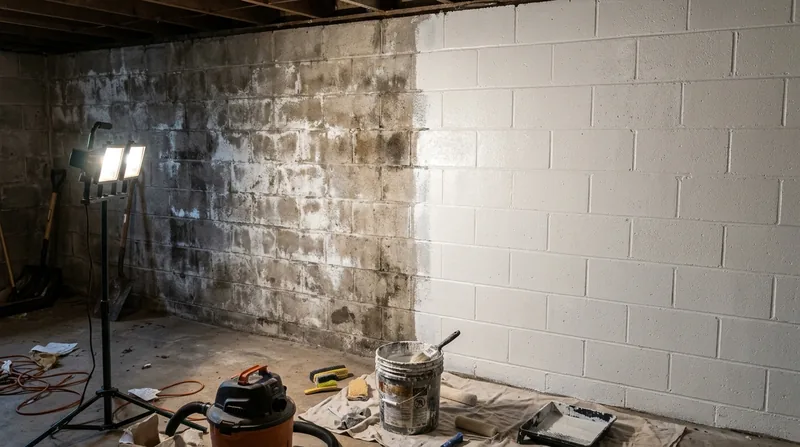




If your basement walls feel damp, show white powder, or weep after a hard summer storm, you are looking at a sealing problem, and Basement Wall Sealing in Germantown is the first step we check before anyone starts digging. Germantown sits in upcounty Montgomery County on clay-loam and silty soil over Piedmont schist and gneiss that weathers into clay, so water leaves the lot slowly and pushes against poured walls. The 1980s to 2000s subdivisions in Kingsview, Neelsville and the town core mostly have poured full basements, and the 1960s and 1970s split-levels and colonials in Montgomery Village add partly finished basements and some block walls to the mix. Spring rains raise the water table, summer storms run off the ridges into the Seneca Creek branches, and freeze-thaw cracks older walls. We prep, strip efflorescence, and apply penetrating or membrane sealers, but we tell you straight when a sealer is not enough. Start with a free basement inspection so we can name the problem before we quote the fix.
Why Damp Walls Show Up in Germantown Basements
Most damp walls we see in Germantown are not a sealing failure, they are a water management failure. The clay-loam holds rain against the foundation, the footing drain may be clogged or missing, and the wall wicks moisture inward until it shows as efflorescence or a musty smell. Sealing treats the surface, so we have to know what is feeding it.
- Poured walls in Kingsview and Neelsville develop hairline shrinkage cracks that seep after heavy rain.
- Block walls in older Montgomery Village homes wick water through mortar joints and hollow cores.
- Stone and early block cellars on farm properties in Damascus and Poolesville hold moisture in the mortar itself.
- Downspouts that dump next to the foundation keep the soil saturated long after the storm passes.
When we find hydrostatic pressure behind the wall, we say so, because a sealer alone will not hold it back.
Key info: A homeowner in the 20876 ZIP code near Kingsview had white efflorescence on a poured wall and assumed the wall was failing. The actual cause was a downspout discharging two feet from the corner. We extended the discharge line, sealed the wall, and the powder has not returned.
Permits for structural foundation work and drainage changes are handled through the local building department, and rules vary by jurisdiction, so verify before work starts. You can check Montgomery County's permit guidance at Montgomery County Department of Permitting Services.
How We Seal a Basement Wall in Germantown
Sealing is a sequence, not a coat of paint. We start by finding the source of the moisture, then we prep the wall so the product can bond, then we seal. Skipping the diagnosis is how homeowners end up resealing the same wall every other year.
- We walk the basement and the exterior grade, checking the floor joint, cracks, window wells and downspout discharge.
- We test for active seepage and note efflorescence, which tells us whether water is moving through the wall or sitting on it.
- We wire-brush and wash the wall to remove salts, loose parging and old failing coatings.
- We patch cracks and the floor joint with hydraulic cement or epoxy where the crack is structural.
- We apply a penetrating sealer on poured walls or a membrane sealer on block and stone walls, depending on what the wall needs.
- We correct grading and downspout extensions so the water has somewhere to go.
If the inspection shows hydrostatic pressure, we explain why an interior drain tile system is the better answer than another coat of sealer.
Key info: A 1970s split-level in Montgomery Village had a block wall that wept every spring. Sealer alone lasted one season. We sealed the wall, repacked the floor joint, and tied the wall into a perimeter drain, and the weeping stopped because the water finally had a path to the sump basin.
Sealing Approaches We Use and When Each One Fits
Not every wall takes the same product. We match the approach to the wall material, the moisture reading and the pressure behind it, and we tell you when sealing is the wrong tool for the job.
| Approach | Description | Best for |
|---|---|---|
| Penetrating sealer | Soaks into the concrete and reacts with free lime to block capillary moisture. | Poured walls with minor dampness and no standing water. |
| Membrane sealer | Forms a flexible film over the surface and bridges hairline movement. | Block walls and walls with fine cracking. |
| Crack injection | Epoxy or polyurethane pushed through injection ports to fill the full crack depth. | Active seeping cracks in poured walls. |
| Parging repair and hydraulic cement | Rebuilds spalled mortar and seals the floor joint before coating. | Older stone and block cellars in Damascus and Poolesville. |
| Sealing plus drainage correction | Sealer combined with grading, downspout extensions and drain work. | Walls that stay wet because the soil around them stays wet. |
We recommend the lightest approach that actually solves the problem, and we tell you when a sealer will not hold.
Basement Wall Sealing Cost in Germantown: What to Expect
Most sealing jobs in Germantown start around $1,500 for a standard basement wall run with prep, crack patching and one sealer system. The number moves with wall length, wall material, how much efflorescence and old coating has to come off, and whether we find active cracks that need injection. A single damp wall is a different job from a full perimeter on a block basement in Montgomery Village.
Access matters too. A finished basement with paneling and shelving takes longer to protect and work around than a bare wall. If the inspection finds hydrostatic pressure, the honest answer may be that sealing alone is a partial fix and the real cost belongs to drainage work. We give you both numbers so you can decide. You can see the full range on our pricing page.
Get two or three estimates and compare what is included, not just the bottom line. A quote that skips prep or crack patching is not the same job as one that includes it.
Choosing a Basement Wall Sealing Contractor Near Me in Germantown
Sealing is easy to sell and easy to do badly, so check the contractor before you check the price. Ask for the license and insurance certificate, ask what prep is included, and ask what happens if the wall is still damp after the first rain. A contractor who cannot answer those questions plainly is not the one you want in your basement.
- Confirm the company is licensed and insured and ask for the certificate, not just a verbal yes.
- Get two or three written estimates that list prep, patching, sealer product and cleanup.
- Ask for local references from Germantown, Gaithersburg or Damascus and call them.
- Ask whether the scope touches structural repair or drainage, because that is when a building permit may be required.
- Check HOA rules in your subdivision before exterior grading or discharge changes begin.
We put the scope in writing and we tell you when the wall needs more than sealer. Reach us through the contact page or call (240) 261-0659.
Basement Wall Sealing in Germantown: Pricing Guide
| Service | Price | Details |
|---|---|---|
| Single wall sealing with prep | Starting at $1,500 | Includes wire-brushing, efflorescence removal, crack patching and one sealer system on a standard wall run |
| Full perimeter sealing, poured basement | Starting at $2,900 | Covers all four walls with penetrating sealer, floor joint sealing and downspout discharge correction |
| Block or stone wall sealing | Starting at $2,400 | Membrane sealer and parging repair on older block and stone walls, which take more prep time |
| Crack injection add-on | Starting at $450 per crack | Epoxy or polyurethane injection for active seeping cracks found during the sealing inspection |
| Complex or large-scale job | On estimate | Finished basements, heavy efflorescence, or walls showing hydrostatic pressure need an on-site look first |
| Estimate | Free | Response within 24 hours at (240) 261-0659, no obligation to book |
Indicative pricing, the exact cost depends on square footage, finish, and site access. Free personalized estimate within 24h at (240) 261-0659.


